Given circumstances: seven questions before you play the scene
A practical way to turn facts in the script into living pressure that shapes every choice.
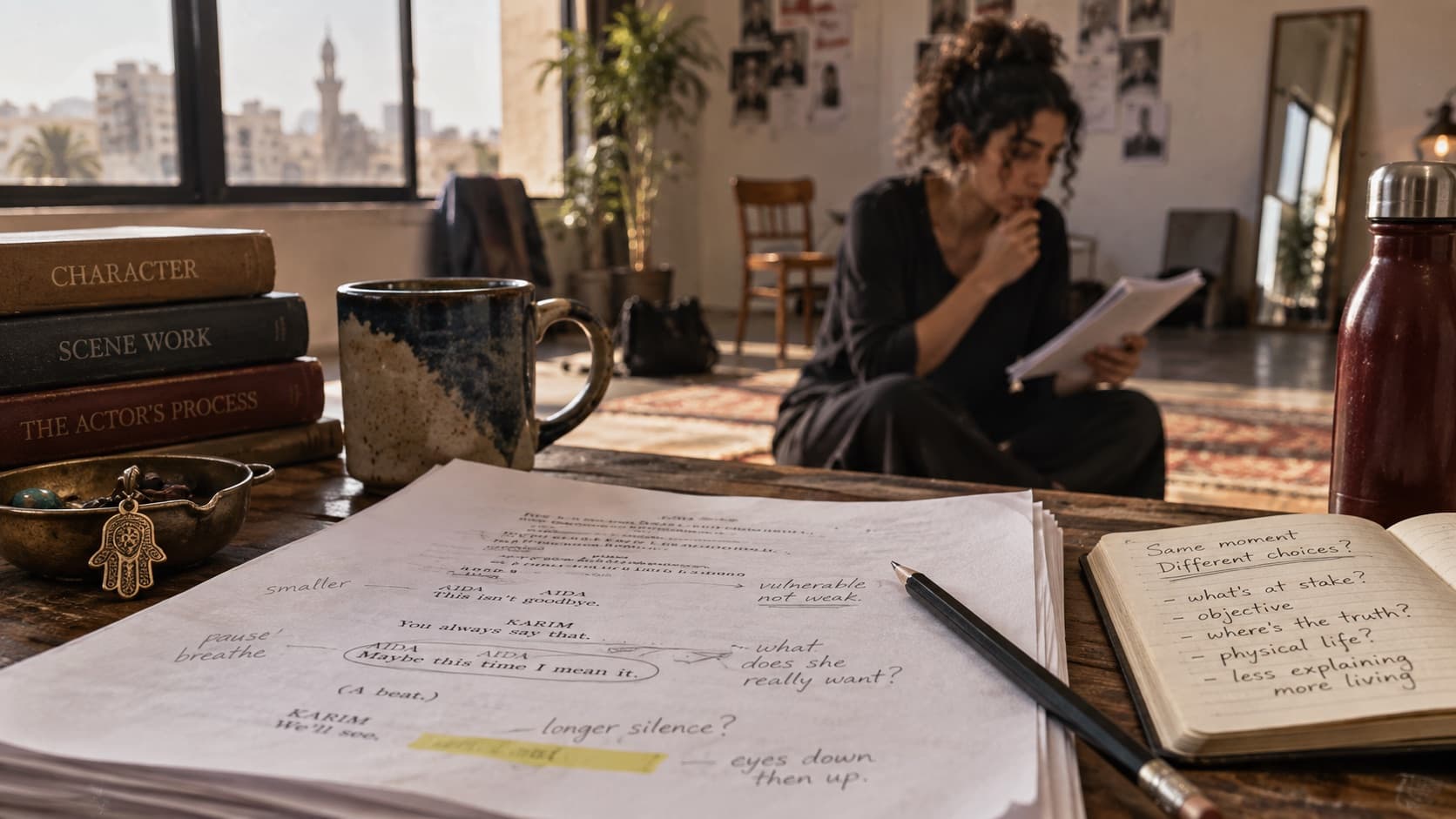
Given circumstances are the facts a script provides about the world of a scene: where and when it happens, what occurred before the entrance, the relationship, and what may be lost. In Stella Adler work, these details are not collected for an academic essay. They become the environment in which the actor behaves.
Before rehearsal ask: exactly where am I? What time and date is it? What happened one minute before the scene? Who is this person and what is our history? What do I want now? What blocks me? What happens if I fail? General answers such as “a house” or “we are friends” rarely create pressure. Specific answers do.
If this is your childhood home after ten years away, the door, chair, and silence are not neutral. If your partner is a brother who ignored every call after a funeral, an ordinary line can carry a long history. You do not explain that history to the audience; you let it organize your attention.
Separate textual fact from inference. Facts remain fixed, while imaginative choices can be tested. Choose a detail that agrees with the script and produces behavior, not a dramatic invention added only for excitement. Drop it if it contradicts later information or muddies the scene.
Try a short exercise. Walk through the rehearsal room as if it were the actual place. Locate the door, source of light, object you avoid, and place where you feel safe. Then begin the text. This is not decoration with extra movement. It trains the imagination until an empty room exerts pressure.
When a performance feels flat, do not begin by adding emotion. Revisit the circumstances. You may not know why this moment matters today, what immediately preceded it, or what failure costs. Dramatic pressure is often already in the text; the actor makes it tangible.